March 26, 2026
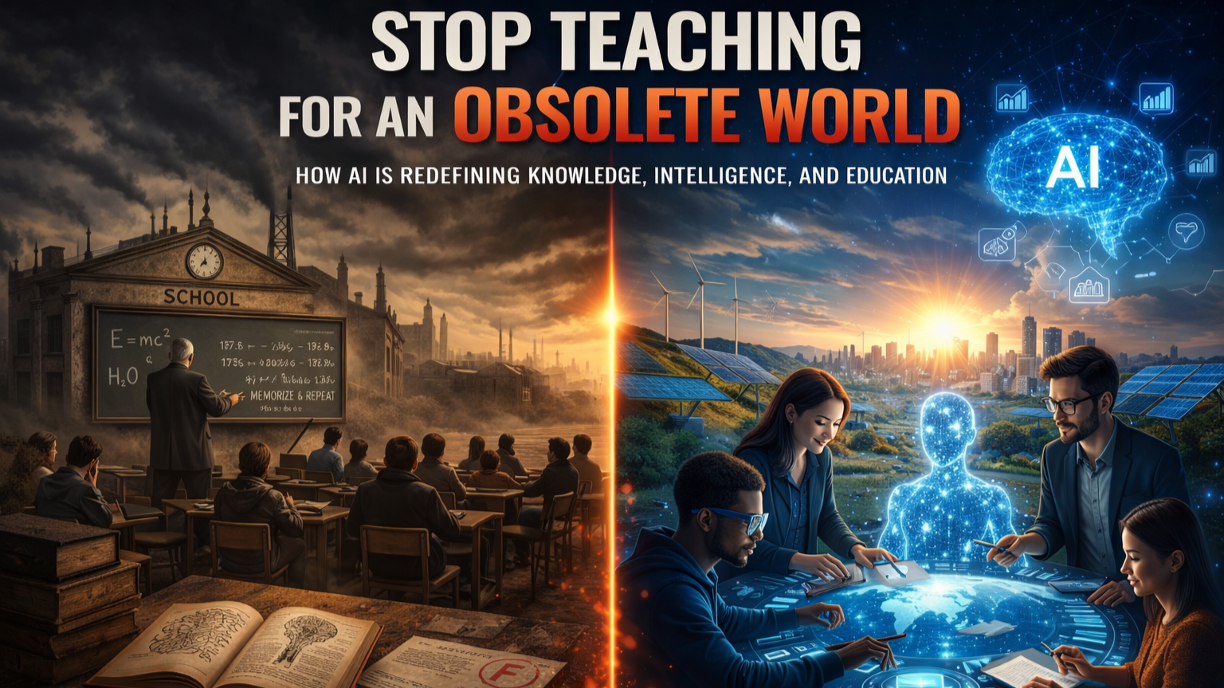
We are still educating students as if intelligence resides solely inside individual minds.
It does not.
Intelligence now operates within a distributed cognitive system—one that spans humans, machines, and the interaction between them. What has changed is not merely the availability of better tools. It is the structure of thinking itself.
And most educational institutions have not yet understood its implications.
Knowledge and Intelligence: The Old Model vs. the New Reality
For centuries, education has been built on a stable set of assumptions about knowledge and intelligence.
In the traditional model, knowledge is something an individual possesses: facts, concepts, and procedures stored in memory and retrieved when needed. Intelligence is the individual capacity to reason, learn, and solve problems using that internal store.
Under that framework:
- Knowledge is possessed
- Intelligence is individual
- Performance is measured through recall and independent problem-solving
AI breaks this model.
Today, knowledge no longer exists only inside human minds. It exists within a distributed system of people and machines—externalized, searchable, continuously updated, and available at scale. Intelligence is no longer confined to the individual. It emerges from the quality of interaction between human judgment and machine capability.
In the AI era:
- Knowledge is distributed and participatory
- Intelligence is relational and system-level
- Performance is measured by judgment, outcomes, and effective human–AI collaboration
This is the central shift:
From knowledge as possession to knowledge as participation. From intelligence as individual capacity to intelligence as system capability.
Education was designed for the former.
It now operates inside the latter.
The Collapse of the Legacy Educational Model
The traditional model of education assumed that knowledge is scarce, that it must be stored in individual minds, and that expertise is defined by accumulation.
AI destabilizes all three assumptions.
Large-scale AI systems now function as a kind of external cognitive layer—able to retrieve, synthesize, and generate knowledge across domains with unprecedented speed. The bottleneck is no longer access to information.
The bottleneck is interpretation, evaluation, and use.
That changes everything.
Memorization loses its privileged status. Disciplinary walls are collapsing. The line between “knowing” and “using knowledge” starts to blur.
Knowledge is no longer something you simply have.
It is something you must engage, test, and direct.
Intelligence Is Now Distributed
If knowledge is distributed, intelligence cannot still be treated as purely individual.
Yet that is exactly how most institutions continue to operate.
Cognitive science has long shown that thinking is distributed across tools, environments, and other people. AI does not create this reality; it radically expands it.
A more accurate definition of intelligence now is this:
That redefinition reshapes the meaning of expertise, learning, and performance.
Expertise becomes the ability to orchestrate cognition. Performance becomes a property of the system, not just the individual. Learning becomes the ability to navigate, direct, and refine networks of intelligence.
Cognitive Work Is Being Rewritten
The transformation is not just about speed or efficiency. It is changing the very nature of cognitive work.
Across domains, AI is shifting what it means to think:
- Information retrieval moves from searching to strategic querying
- Memory moves from recall to verification
- Comprehension moves from absorbing content to interpreting outputs
- Analysis moves from producing insights to evaluating machine reasoning
- Synthesis moves from generating ideas alone to guiding AI-generated combinations
- Problem-solving moves from execution to problem framing
- Decision-making moves from selecting options to judging uncertainty
- Creativity moves from human production to co-creation with AI
- Communication moves from expression alone to translation across human and machine systems
- Learning moves from content absorption to continuous adaptation
This is not simple augmentation.
It is a redefinition of cognition.
The Epistemic Inversion
AI is often described as automation.
That description is too small.
This is the third major transformation in human history:
- Agriculture transformed biological survival
- Industry transformed physical labor
- AI transforms cognitive labor—and the structure of knowledge itself
More importantly, AI changes how knowledge is produced and how truth is established.
AI can generate explanations, arguments, hypotheses, and answers.
What it cannot do is guarantee that any of them are correct.
That creates a profound inversion:
This is the defining epistemic condition of the AI era.
From Knowing to Judging
As generation becomes abundant, the human role shifts.
The central cognitive task is no longer producing knowledge from scratch.
It is judging knowledge.
That means the most important movement is not from ignorance to information, but from information to discernment.
The new cognitive priorities become:
- From recall to recognition
- From generation to evaluation
- From solving problems to framing and validating them
In this environment, the defining challenge is no longer access to knowledge.
It is determining what is reliable, what is flawed, and what is worth acting on.
The End of Disciplinary Boundaries
Traditional disciplines were built on fragmentation. They divided knowledge into stable domains, each with its own methods, language, and internal logic.
AI is rendering that structure obsolete.
It creates a shared knowledge environment in which cross-domain connections are no longer exceptional; they are native. Problems increasingly resist disciplinary containment, and AI makes it easier to move across fields in real time.
This is not merely interdisciplinary.
It is post-disciplinary.
Knowledge is no longer organized primarily by fields.
It is organized by problems, systems, and decisions.
Why Current Education Is Structurally Misaligned
Despite these changes, most educational systems remain grounded in outdated assumptions.
Their response to AI has been visible, but shallow: new tools, pilot programs, committees, policy statements.
The surface changes.
The underlying theory of knowledge does not.
Students are still assessed by what they can recall, what they can produce independently, and how well they perform inside disciplinary silos. Institutions are trying to add AI to an educational architecture designed for a world in which intelligence was presumed to be isolated, internal, and individual.
That is a structural mismatch.
That is not transformation.
It is innovation theater.
Toward an AI-Native Model of Education
If knowledge and intelligence have changed, education must change at the level of first principles.
Three shifts are essential:
- Learning as interaction: the ability to query, guide, and refine AI-generated knowledge
- Intelligence as system performance: the ability to work effectively within human–AI cognitive systems
- Truth as evaluation: the ability to assess, validate, and justify what should be trusted
In this world, the most valuable skill is not producing more answers.
It is knowing which answers deserve confidence—and why.
A New Cognitive Curriculum
An AI-native curriculum should not be organized around tools alone. It should be organized around epistemic capability: the ability to operate effectively within a distributed knowledge environment.
That means shifting from content delivery to cognitive design.
Students must learn:
- Metacognition: how to monitor their own thinking, decide when to rely on AI, and know when to challenge it
- Evaluation of machine-generated knowledge: how to check sources, test reasoning, identify hallucinations, and detect bias
- Reasoning under uncertainty: how to make defensible decisions with incomplete information and probabilistic outputs
- Cross-domain synthesis: how to connect ideas across fields and frame problems that do not fit neatly inside one discipline
- Decision-making in ambiguous environments: how to weigh trade-offs, justify judgment, and act without false certainty
This also requires a pedagogical redesign:
- Move from assignments to scenarios, replacing closed tasks with open-ended, real-world problems that require human–AI collaboration
- Move from individual output to system performance, assessing how well students design prompts, curate evidence, and validate results
- Move from static curricula to adaptive workflows, using live tools, iterative feedback, and fast cycles of hypothesis, testing, and revision
Assessment must change as well.
We should measure:
- Process quality, not just final answers
- Outcomes and judgment, not just retained content
- Justification, including why a conclusion was trusted, what alternatives were rejected, and on what grounds
The goal is no longer to produce knowledge holders.
It is to develop people who can navigate, orchestrate, and govern distributed intelligence systems with rigor, judgment, and accountability.
The Stakes for Academic Medicine
Nowhere is this more urgent than in healthcare.
Medicine is already a distributed cognitive system. Diagnosis is increasingly augmented. Decision-making is hybrid. Clinical knowledge is continuously updated and algorithmically mediated.
If education does not evolve to match that reality, we will keep training professionals whose model of thinking no longer fits the systems in which they must operate.
The danger is not simply falling behind.
The danger is training the wrong kind of intelligence.
Conclusion
AI is not just changing education.
It is changing what knowledge is, what intelligence is, and what learning demands.
The mind is no longer the sole container of cognition. Knowledge is no longer something merely possessed. Intelligence is no longer strictly individual.
This is not a minor curriculum revision.
It is a new epistemology of education.
Final Thought
We are not merely preparing students to use AI.
We are preparing them to live and think inside a new theory of knowledge.
The question is no longer how to integrate AI into education.
© 2026 Jiajie Zhang. All Rights Reserved.