The office remains. The title remains. The salary arrives.
But students find better explanations elsewhere. Collaborators choose more capable teams. Emerging research questions are defined by people working differently.
You are still employed. You are becoming less necessary.
That is the possibility professors should take seriously.
AI does not need to possess everything you know, reproduce your experience, or replace your entire profession to change the value of your work.
It only needs to change what others can accomplish without depending on you.
1. History’s Warning: Expertise Survives by Changing
Before a computer was something you bought, it was someone you hired.
Human computers performed demanding mathematical work essential to aeronautics and space research. NASA’s history documents how these specialists developed calculation methods, contributed to research, and, with the arrival of electronic computers, took on programming responsibilities (Loff, 2016). Their expertise mattered. Its relationship to the work changed.
Calculation did not disappear. The organization of calculation changed.
The lesson is not that experts inevitably become unemployed. Autor (2015) explains that automation can substitute for particular tasks while complementing others, expanding production and creating new demands for human work. But the survival of employment does not mean the preservation of existing jobs, methods, or rewards.
A profession can survive while its traditional basis of authority does not.
Professors should resist the comforting conclusion that because universities survived printing, calculators, and the internet, our current practices deserve another lifetime.
History does not reward a profession simply because its members worked hard to enter it.
The years you spent acquiring expertise are real. They are not a contract obligating the future to value that expertise in its present form.
2. The Evidence: Academic Work Is Being Reorganized
2.1. Doctoral Education: A Dissertation Is Not Enough
At a Harvard-hosted summit in September 2026, mathematicians recommended substantial changes to doctoral education. Written work should no longer serve as the primary proxy for understanding. Programs should strengthen in-person assessment, require rigorous thesis defenses, and emphasize communication, question formulation, and thoughtful engagement with AI (Report of Summit, 2026). These were recommendations, not a declaration that AI had made mathematicians unnecessary.
But they confront an uncomfortable distinction:
Producing an impressive intellectual artifact is no longer sufficient evidence of the intellectual capability of its producer.
That problem applies to students. It should also make professors examine what we reward in ourselves.
2.2. Teaching: Expertise Can Be Relocated
Kestin et al. (2025) reported a randomized crossover study involving 194 Harvard physics students across two lessons. A carefully designed AI tutor produced greater immediate learning gains than in-class active learning. This was not evidence that a chatbot could replace an entire degree, sustained mentorship, or a professor’s responsibilities. It was evidence that important instructional functions could be reorganized.
The tutor did not eliminate pedagogical expertise. Its design incorporated it.
The expertise was not simply replaced. It was relocated.
That is the more consequential story.
3. Distributed Cognition: Your Competitor Is Not Just Another Brain
In 1994, Don Norman and I published research on cognitive tasks that depend on information represented both internally, in the mind, and externally, in the environment. Distributed cognition changes the unit of analysis: to understand performance, we must examine the organized system, not just the individual brain (Zhang & Norman, 1994).
This is the foundation of the argument I develop in The Cognitive Revolution and extend in Beyond AGI (Zhang, 2026a, 2026b).
Scientific intelligence has never belonged to the professor alone. It operates across people, literature, instruments, data, representations, software, and institutions. AI changes what these components can do and how their work can be coordinated. The transformation is not simply cognitive “offloading.” It is the reorganization of cognition (Zhang, 2026a).
Consider a field experiment involving 791 professionals at Procter & Gamble. Individuals working with AI matched the performance of two-person teams without AI on product-innovation challenges. AI also helped participants produce proposals that better integrated technical and commercial perspectives (Dell’Acqua, Ayoubi, et al., 2026). This was a bounded experiment, not proof that teams are obsolete. But it demonstrates that the relationship between individual expertise and collective capability can change.
The implication for academia is substantial.
A colleague may know less than you personally yet participate in a system capable of accomplishing more. That colleague might be your former student. It might also be a senior scholar who combines decades of judgment with a radically redesigned research process.
The dividing line is not age. It is whether expertise can reorganize itself.
Nor is an AI subscription sufficient. In an experiment involving 758 consultants, AI accelerated suitable tasks, but on a task beyond its capabilities, AI users were 19 percentage points less likely to reach the correct answer (Dell’Acqua, McFowland, et al., 2026). More technology did not automatically produce better thinking.
The future professor is not a ceremonial human signature at the end of an AI pipeline.
The opportunity is to design systems that ask better questions, generate alternatives, test claims, expose errors, and develop understanding. Judgment belongs throughout that process, not merely at its conclusion.
4. Inaction: You Can Be Displaced Without Being Fired
Here is the displacement scenario I worry about. It need not begin with a termination letter.
It can begin when your lectures become less useful than the alternatives available to your students.
It can continue when your research process becomes slower, narrower, or less ambitious than the processes used by competing groups.
Eventually, you may still occupy the position while other people define the field.
Intellectual displacement can precede employment displacement.
Who takes over?
Potentially, AI-fluent colleagues, interdisciplinary teams, former students, or institutions that redesign education and research around more capable human-AI systems. Sometimes responsibilities may be redistributed without anyone being formally replaced. Positions may change when incumbents leave.
These are possible organizational responses, not outcomes established by the experiments above. Different disciplines and institutions will move differently.
But waiting for certainty is also a choice.
A professor who refuses to investigate changing methods is effectively betting that the value of established expertise will remain stable until retirement.
That is a remarkably speculative position for someone who insists on evidence.
Your retirement date is a personal plan. It is not a technological timetable.
5. Reinvention: Change the Work, Not Just the PowerPoint
The response cannot be limited to generating lecture slides faster or polishing manuscripts more efficiently.
If AI only improves your sentences, you may be protecting your assumptions.
5.1. Research: Challenge the Hypothesis, Not Just the Wording
Use AI to challenge a favored explanation, surface competing hypotheses, explore unfamiliar methods, and identify what evidence would distinguish a plausible story from a valid finding.
Then build verification into the process.
The goal is not to produce more scholarship that looks like your previous scholarship. It is to expand what you can investigate and improve how you determine what is true.
5.2. Teaching: Develop Capability, Not Just Deliver Content
Redesign the relationship between preparation, practice, dialogue, feedback, and assessment. Ask students to explain decisions, defend interpretations, investigate failures, and demonstrate both independent understanding and effective collaboration with AI.
Neither blind delegation nor blanket prohibition is an educational philosophy.
Students need to learn both how to think without AI and how to accomplish more with it.
5.3. Faculty Excellence: Reward Intellectual Adaptability
Make intellectual adaptability an explicit dimension of faculty excellence.
Not how many AI tools someone uses. Not how many additional papers they produce. Whether they can question assumptions, improve methods, redesign learning, and create demonstrably better scholarship.
Universities must support that work with time, training, appropriate infrastructure, and meaningful recognition. Demanding reinvention while rewarding only the old activities is institutional hypocrisy.
Academic freedom must protect serious criticism of AI. But criticism should be evidence-based. So should adoption.
A single hallucination is a reason to examine reliability. It is not a reason to declare the transformation canceled.
6. The Final Warning: Preserve the Expertise, Not the Old Arrangement
My argument is not that knowledge no longer matters.
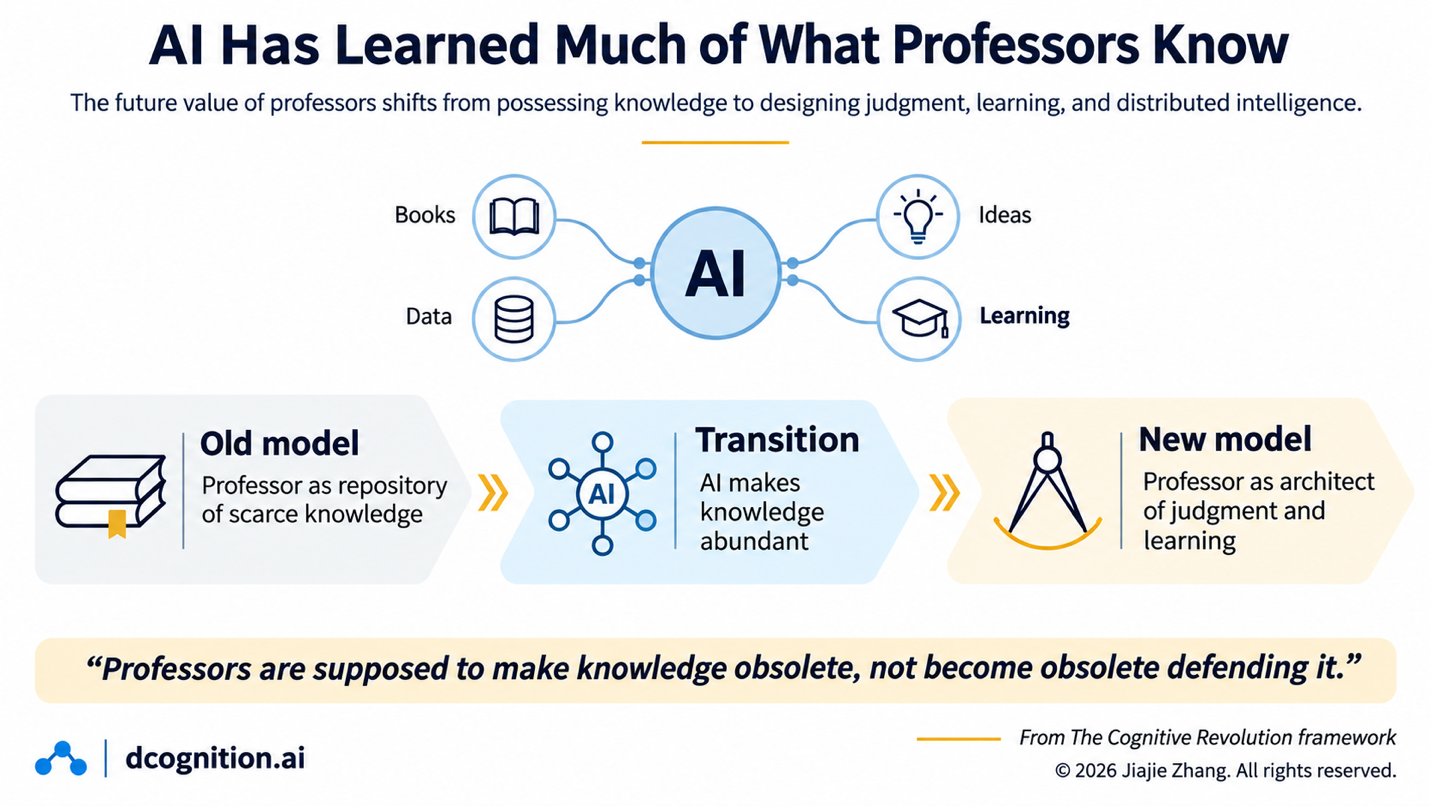
It is that possessing knowledge and creating intellectual value are becoming less interchangeable.
The Cognitive Revolution is not merely a contest between professors and machines. In my framework, it is a transformation in how intelligence is organized, how expertise becomes productive, and how institutions turn expanding capabilities into learning and discovery (Zhang, 2026b). dcognition.ai
That creates an extraordinary opportunity for experienced scholars.
Deep expertise can become more powerful when it is connected to a better cognitive system. But only if we stop treating the preservation of our existing practices as the purpose of the profession.
We need the courage to make our familiar methods and teaching practices obsolete by creating something better. Otherwise, we risk becoming obsolete while defending them.
Our responsibility is not to preserve the academic work that made us successful.
It is to build the forms of scholarship and education that deserve to come next.
Professors are supposed to make knowledge obsolete, not become obsolete defending it.
References
Autor, D. H. (2015). Why are there still so many jobs? The history and future of workplace automation. Journal of Economic Perspectives, 29(3), 3–30. https://doi.org/10.1257/jep.29.3.3
Dell’Acqua, F., Ayoubi, C., Lifshitz, H., Sadun, R., Mollick, E., Mollick, L., Han, Y., Goldman, J., Nair, H., Taub, S., & Lakhani, K. R. (2026). The cybernetic teammate: A field experiment on generative AI and teamwork. Organization Science, 37(4), 1217–1242. https://doi.org/10.1287/orsc.2025.20702
Dell’Acqua, F., McFowland, E., III, Mollick, E., Lifshitz, H., Kellogg, K. C., Rajendran, S., Krayer, L., Candelon, F., & Lakhani, K. R. (2026). Navigating the jagged technological frontier: Field experimental evidence of the effects of artificial intelligence on knowledge worker productivity and quality. Organization Science, 37(2), 403–423. https://doi.org/10.1287/orsc.2025.21838
Kestin, G., Miller, K., Klales, A., Milbourne, T., & Ponti, G. (2025). AI tutoring outperforms in-class active learning: An RCT introducing a novel research-based design in an authentic educational setting. Scientific Reports, 15, Article 17458. https://doi.org/10.1038/s41598-025-97652-6
Loff, S. A. (2016, November 25). When the computer wore a skirt: Langley’s computers, 1935–1970. NASA. https://www.nasa.gov/history/langleys-computers-1935-1970/
Report of summit on PhD math education in the age of AI. (2026). Harvard University, Center of Mathematical Sciences and Applications. https://cmsa.fas.harvard.edu/media/2026/09/Summit-on-PhD-Math-Education-in-the-Age-of-AI.pdf
Zhang, J. (2026a, August 3). Beyond AGI: How frontier models are computationalizing distributed intelligence. Substack. Read “Beyond AGI” on dcognition.ai
Zhang, J. (2026b). The cognitive revolution: How AI is reorganizing intelligence, expertise, and institutions. Open Intelligence Press. (https://www.amazon.com/dp/B0GWMHQSNG)
Zhang, J., & Norman, D. A. (1994). Representations in distributed cognitive tasks. Cognitive Science, 18(1), 87–122. https://doi.org/10.1207/s15516709cog1801_3
Continue Reading and Watching
This framework is based on my book, The Cognitive Revolution: How AI Is Reorganizing Intelligence, Expertise, and Institutions.
Book: https://www.amazon.com/dp/B0GWMHQSNG
Video and the story behind its creation: https://jiajiezhang100.substack.com/p/four-hours-one-ai-twin-did-this-video
Website: https://www.dcognition.ai
How This Essay Was Created
I originate the ideas, arguments, conceptual framework, conclusions, and the first draft of every essay. I then use AI as a cognitive partner to challenge my thinking, improve organization, strengthen clarity, and refine the writing. The intellectual contributions are my own. This collaborative process reflects the central thesis of The Cognitive Revolution: intelligence increasingly emerges through distributed cognitive systems.
© 2026 Jiajie Zhang. All rights reserved.
Brief quotations with attribution and a link to the original publication are welcome. No part of this article may be reproduced, republished, or distributed in whole or in substantial part without prior written permission from the author.
No approved comments yet. You can begin the discussion.